31 August 2026

As Women’s Month draws to a close, there is a familiar temptation to celebrate women’s resilience and achievements. All of those things are worth recognising; however, recognition on its own does very little to change the conditions under which women live and work.

This is particularly true in the care economy where so much of the essential work women do remains poorly recognised and undervalued. Early learning is one such case. Across South Africa, thousands of women run early learning programmes (ELPs) from homes and community spaces. These programmes give young children opportunities to learn and develop, create livelihoods for the women who provide them, and make it possible for other caregivers, particularly women, to participate in work or study. In low-income communities, they are part of the social and economic infrastructure that keeps families and local economies going.

Yet the economics remain precarious. Research notes that programme fees in lower-income communities average between R218 and R313 per month, while nearly 90% of ELP staff earn below the national minimum wage [ECD Census, 2021Thrive by Five, 2022]. While the existing government subsidy provides some relief, the amount is insufficient to cover all costs. Moreover, provider costs, household poverty and regulatory requirements all reinforce one another. The result is that ELPs serving low-income communities face infrastructure and compliance costs they cannot absorb, while the families they serve cannot pay higher fees.

The maths simply does not work if we expect parent fees and the ingenuity of individual women to carry the system.

This is where scaffolded support matters. SmartStart and Harambee’s paper, developed for the 2025 G20 Conference on Financial Inclusion and Women’s Empowerment, argues that expanding early learning access requires an environment in which more women can establish and sustain quality programmes over time. This scaffolded support can include programme start-up assistance, access to suitable venues and infrastructure, help navigating compliance and registration processes, training and coaching, business support, quality assurance, and pathways into public financing.

Many organisations in the sector already provide different forms of scaffolded support. SmartStart’s delivery platform helps practitioners with recruitment and programme set-up, training, coaching, quality support and navigating registration. IMBE’s 12-month Accelerator Programme offers targeted business management support to ELPs through the development of financial and business acumen, and assistive technology. Public Employment Programmes (PEPs) have also shown how temporary income support can reduce some of the risk involved in entering this ecosystem. These efforts are important but also cannot compensate for gaps in the wider system.

South Africa has committed to universal access to quality early learning by 2030. Realising this ambition requires government, civil society and other partners to create the conditions in which early learning provision can be scaled and sustained. Recent increases in public investment, the Mass Registration Drive and wider regulatory changes are important steps towards this but, significant barriers remain in reaching the most excluded children in communities.

For early learning to become a meaningful path into livelihoods for women and a foundation for children’s development, the answer cannot be to tell women to become more resilient, entrepreneurial or financially savvy. Many already are. The question is what government, civil society and other actors put around them so that their work can become sustainable.

This means financing that reflects what quality provision actually costs, and supporting women from the point at which they are trying to establish programmes, through to the period before they can access the ECD subsidy and beyond. It means investing in infrastructure, training and the wider support systems that make quality provision possible at scale. It also means finding better ways for government and non-state actors to combine their different capabilities, rather than expecting either providers or government to do everything alone.

Ultimately, recognising women’s contribution must mean more than celebrating what they manage to achieve despite difficult conditions. It requires that the conditions be changed so that the work women are already doing can offer a viable livelihood and enable South Africa to realise its commitment to quality early learning for every child.
Download Report

6 May 2026

Insights and Pathways from the 2025 National Systems Mapping Workshop

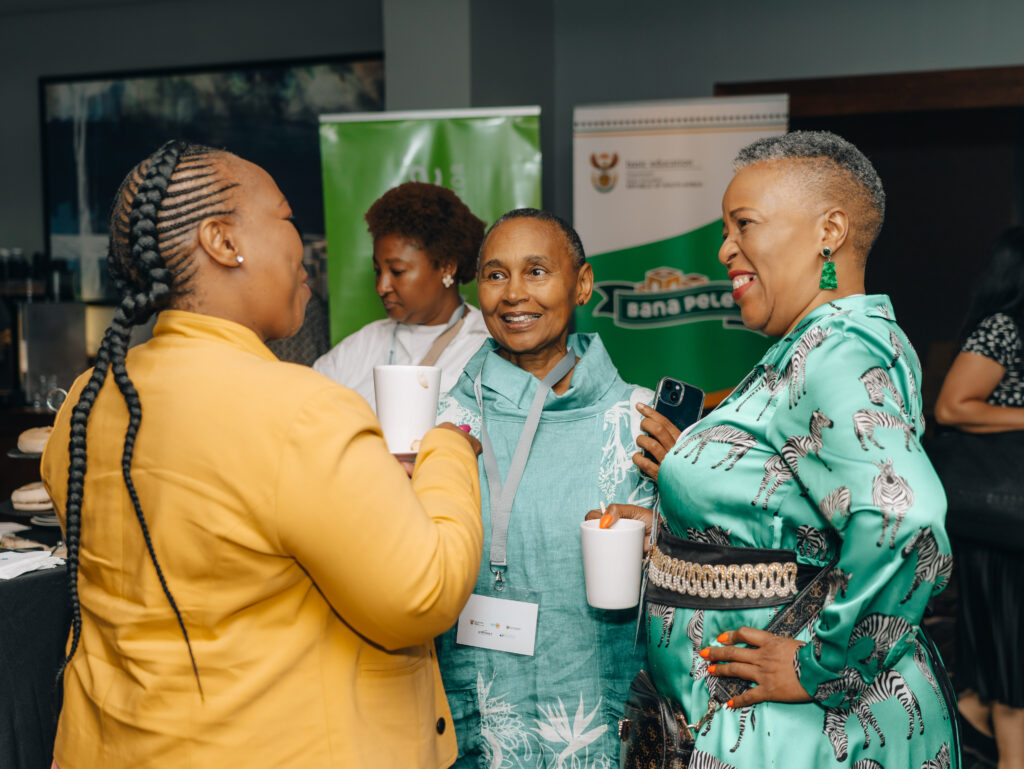
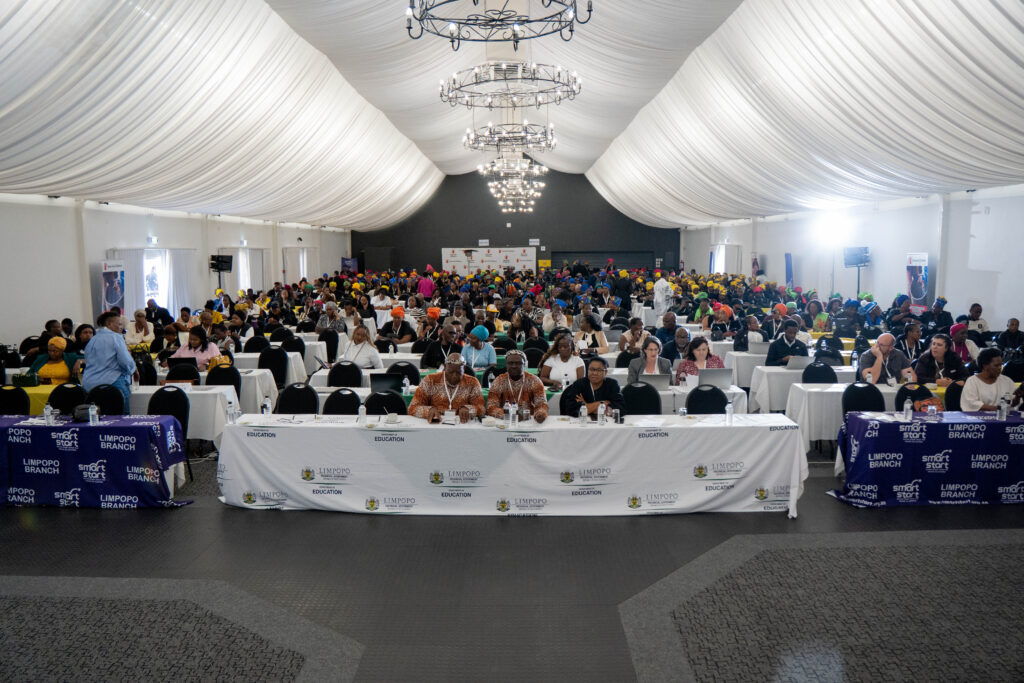
In October 2025, SmartStart, the Department of Basic Education (DBE), Ilifa Labantwana, Harambee Youth Employment Accelerator, and the Early Childhood Development Action Network (ECDAN) convened a two-day Early Childhood Care and Education (ECCE) Systems Mapping Workshop. Early childhood practitioners, parents, government officials, civil society organisations, funders, academics, and international partners – all key role-players in children’s welfare, came together to examine how South Africa’s ECCE system functions in practice, and to identify the shifts necessary to reach every child, especially the most excluded. This took place in the context of significant strides towards the goal of universal ECCE access in recent years.

The report outlines key findings from the session, and highlights stakeholder insight on forging more deliberate public-private partnerships around shared goals. It calls for elevating the value of care work, centering families and communities in solutions and driving a fundamental mindset shift to make sustainable change a reality. 

Download Report

25 November 2025

South Africa stands at a crossroads in early childhood care and education (ECCE). The 2030 Strategy for ECD Programmes, Children’s Amendment Bill, mass registration drive, and rising public investment signal real political will for universal access. SmartStart proves home- and community-based programmes can reach excluded children at scale.

Yet fragmentation stalls progress given regulatory complexity, undervalued practitioners, uneven access, and siloed efforts across government, NGOs, and communities.

Systems mapping workshop

SmartStart co-hosted a landmark ECCE Systems Mapping Workshop in Johannesburg with the Department of Basic Education (DBE), Ilifa Labantwana, Harambee Youth Employment Accelerator, and ECDAN. Over two days, diverse voices of practitioners, parents, officials, funders, academics, and global peers from India and Peru, decoded coordination barriers using systems thinking.

Looking beyond symptoms using the iceberg model

Traditional fixes treat ECCE symptoms in isolation: build more crèches, train more practitioners, advocate for more policy. Systems thinking dives exposing:

  1. Events (what we see)
  2. Patterns (what repeats),
  3. Structures (what enables them)
  4. Mental models (deep beliefs).

Realities surfaced

During the workshop participants shared insights into their realities. Practitioners expressed feelings of chronic undervaluation as care work is often seen solely as “women’s work” or unskilled labour and as such, remuneration is woefully inadequate and they often find themselves buried in red tape without support. Caregivers highlighted economic pressures, safety fears, transport barriers, and gendered child-rearing norms as highly influential in their daily choices. Participants also identified the compounding nature of inequality for children, especially those with disabilities, that often, early barriers are ignored and that formal Grade R is often seen as the “real” start. These are not isolated issues but interconnected feedback loops.

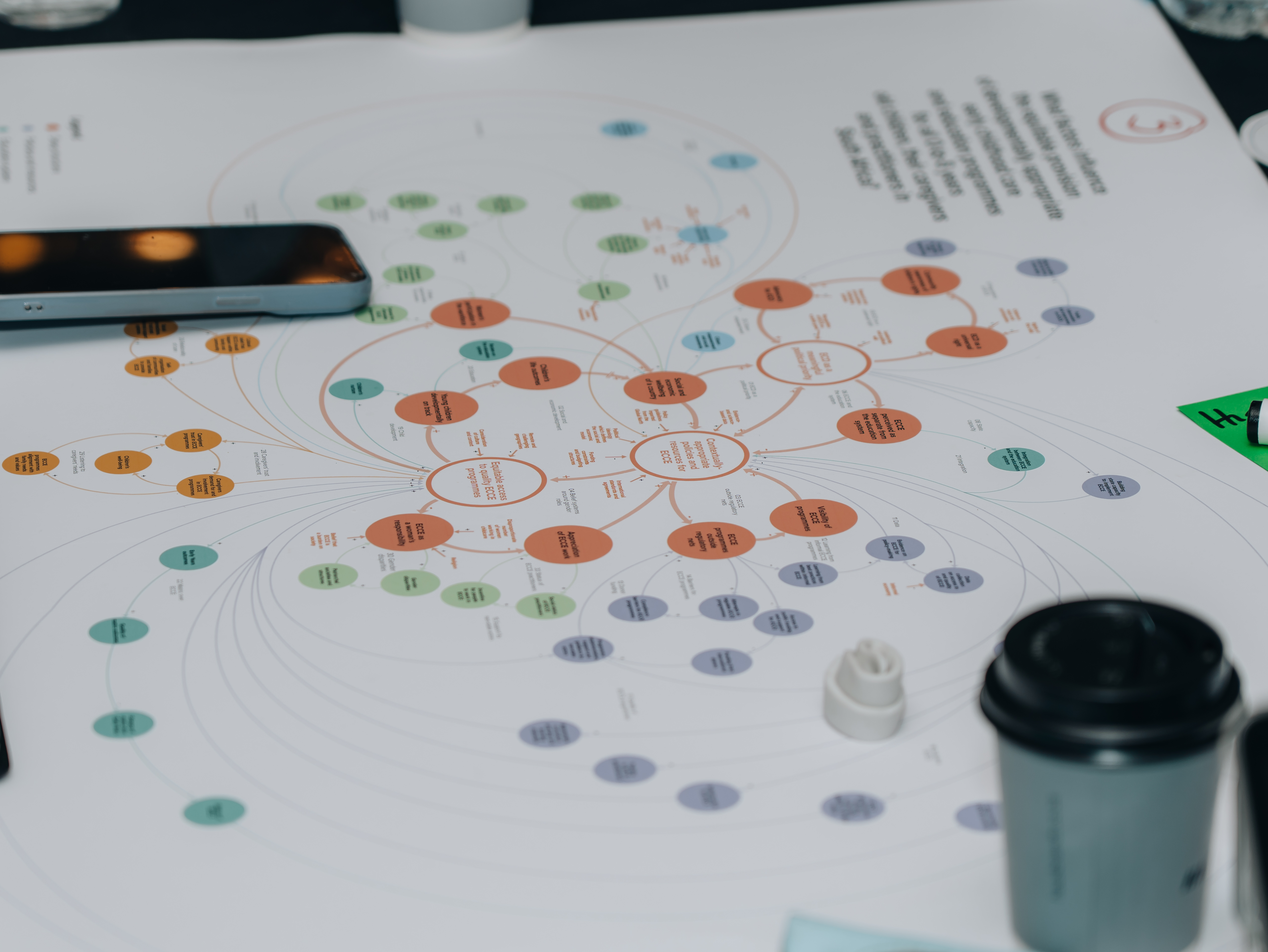
Using a global ECCE systems map, a causal-loop diagram that shows how different factors interact, reinforce one another, and shape how ECCE operates in South Africa, participants surfaced different experiences, tested assumptions, and explores ways of achieving more coordinated, high-leverage action across the ecosystem. Through its close interrogation, participants surfaced gaps on the map, including:

  • Deep structure blind spots: Family practices, social norms, nutrition/security basics underrepresented as the map leans heavily on law, policy and political priority.
  • State vs. reality: Map assumes formal capacity while ECCE in South Africa leans heavily on informal/non-state actors.
  • Naming the exclusion: Migrant and other undocumented children, child-headed households, disabilities need explicit focus that reflects the unique challenges of each group, not a misnomer such as “vulnerable children”.

Participants did not limit their engagement to just diagnosing the problem, but proposed necessary high-leverage changes:

  • Stronger national-provincial-local alignment as well as state-NGO collaboration for registration or compliance support.
  • Better wages, stability, career pathways, mentoring and professional support through existing mechanisms such as Social Employment Fund (SEF), SETAs and other funding streams
  • Two-way information flows between policymakers and practitioners are needed, ensuring that decisions are informed by what is happening on the ground.
  • Mapping “who does what” to cut duplication, and leveraging shared assets such as curriculum, training materials and digital tools.
  • Engage parents/local leaders to shift norms, build demand. Participants emphasised the need to move from designing for communities to working with them, ensuring that local voices influence decisions about resources, programme design and implementation.

The workshop made one truth impossible to ignore: progress will not come from doing more of the same. It will come from organising ourselves differently, listening differently, and widening the circle of who shapes solutions.

Real transformation will require working alongside those who influence other parts of the system – feminist and labour movements, unions, local leaders, community networks, government departments we rarely bring into ECCE conversations and many others – recognising that early learning does not live in a silo, and neither should we.

19 February 2025

The SmartStart network’s landmark new study, shows that early learning programmes run in homes and community venues such as churches and halls are boosting development and learning outcomes for children.

The network comprises 13 implementing partners which, together, support more than 15 000 early learning practitioners to reach over 150 000 children across South Africa each week. With this kind of scale, in 2023 a team of independent researchers gathered data on outcomes for children in SmartStart early learning programmes, to investigate whether the positive impacts identified in a 2018 evaluation, three years after SmartStart’s establishment, were being maintained. 

The researchers tracked the progress of 551 children in 325 SmartStart programmes over eight months, using the Early Learning Outcomes Measure (ELOM) – making it the largest study of its kind to date in South Africa. They found that the proportion of children “on track” increased by a remarkable 20 points from 45% to 65%, while the proportion of those “falling far behind” nearly halved. This meant a dramatic reduction in the achievement gap between children from low- and high-income households, falling from 25 points to just six points.

These results tell two stories:

  1. Every child has infinite potential: Regardless of their background, every child in South Africa can thrive when given the opportunity of quality early learning. It is therefore our responsibility as a society to ensure that this potential is fully released.
    1. Women are powerful change agents:  Thousands of underemployed women in low-income communities are the unlikely heroes – or perhaps the likely heroes – of this study. With basic training, they are delivering powerful outcomes for children.

In some ways, these findings upend conventional notions of “quality” in early learning. Quality is not about shiny infrastructure; it is about simple, everyday practices: nurture, talk, and play. This “alchemy” fuels brain development, physical growth, and emotional wellbeing.

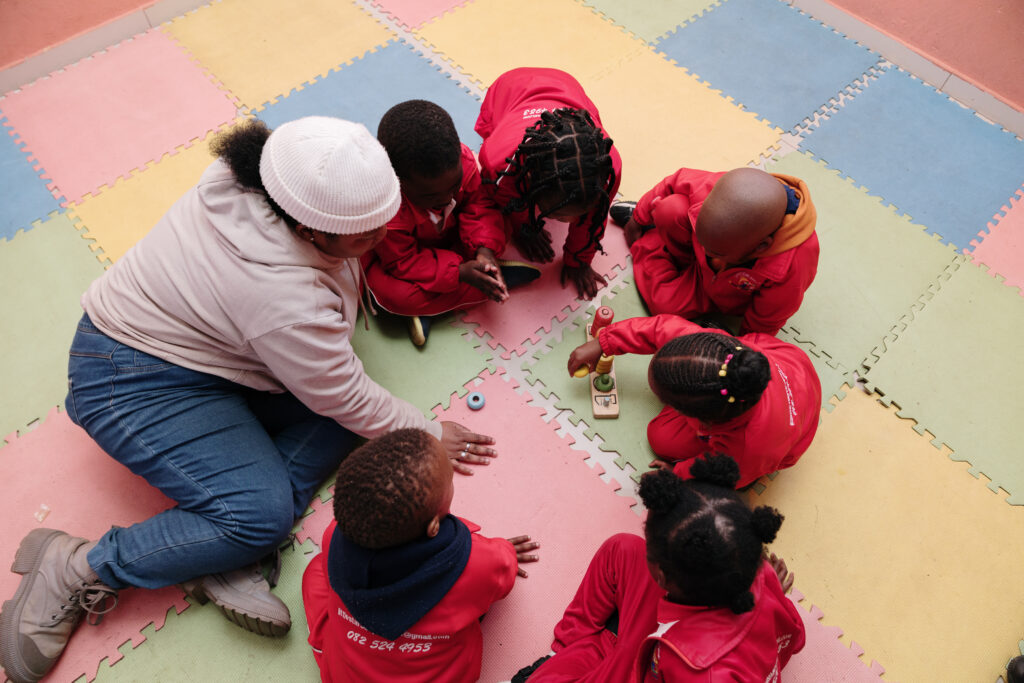
SmartStart’s approach is underpinned by a deep respect for the inherent strengths of communities – and a commitment to make them count. In practice, this means capacitating local, underemployed women in low-income areas, to use available venues to host quality early learning programmes. Most are in homes, often in converted extensions, while some use

These results matter because at a sector leadership summit in March 2025, the President announced that early childhood development was a national priority. The government committed to universal access to early childhood development as far back as 2010, but more than one million new places in early learning programmes are still needed to achieve this. This scale of task requires new solutions, which are pragmatic, affordable and immediate. So, if an early learning delivery platform focused on home and community-based settings in low-income communities can shift outcomes for children as it goes to scale, it strongly signals the path to equitable, quality access. And this understanding should in turn inform more enabling approaches to government regulation and funding.Poverty is not attractive. Our justified rejection of unacceptable living conditions however, should not mean a rejection of the dignity and possibilities that people create for themselves and their communities in these contexts. When we pay attention to the value of what is already there, and focus on assets – such as capable women, home and community venues and informal economic activity – rather than scarcity, the opportunities for transformation are endless. Far from being considered an inferior form of provision, quality early learning programmes in homes and community venues should be elevated as today’s solution for today’s children