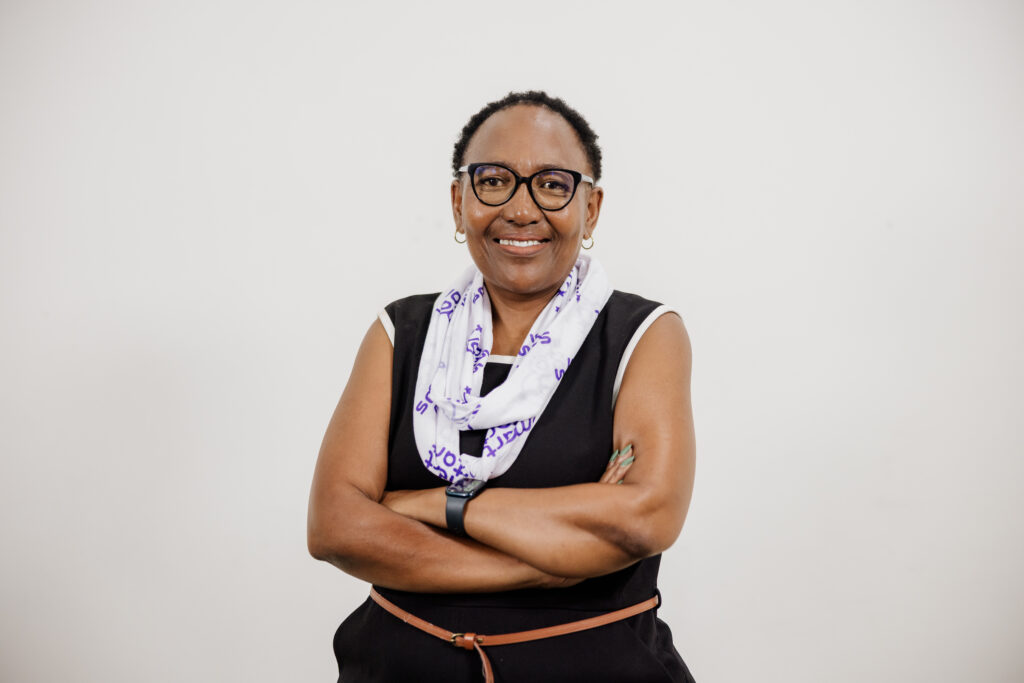
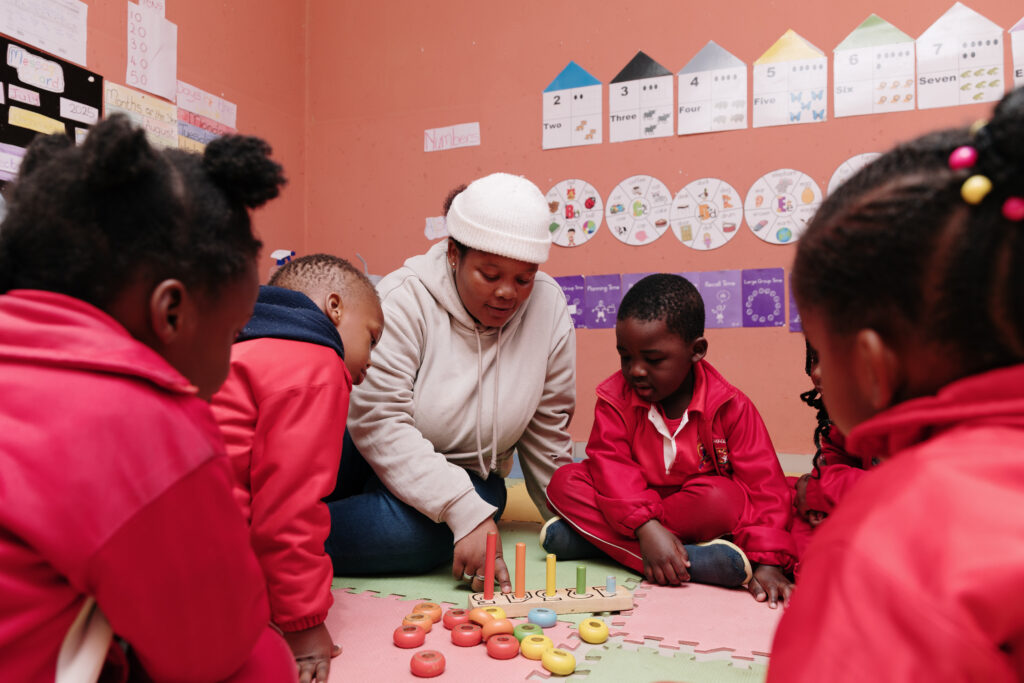
SmartStart’s work is rooted in a simple but powerful belief: every child deserves access to quality early learning from the start. In a recent feature with Business Minds Media, CEO Grace Matlhape shares more about the SmartStart’s vision, the importance of early learning in South Africa, and the role the organisation plays in helping to build stronger foundations for children, families, and communities.
The conversation highlights the scale of the challenge, but also the opportunity to create meaningful change by supporting practitioners, strengthening systems, and expanding access to early learning in communities that need it most. It is a reminder that investing in young children is about education along with dignity, equity, and long-term social impact.
South Africa’s recent commitments in ECCE are significant and worth naming. The 2030 Strategy for ECD Programmes, the Children’s Amendment Bill, the mass registration drive, and the newly published Bana Pele Shared Blueprint — which calls for a shift from slow, linear progress toward rapid, exponential transformation — reflect a sector that is moving. And yet too many children, particularly those in the most marginalised communities, are still not reached.
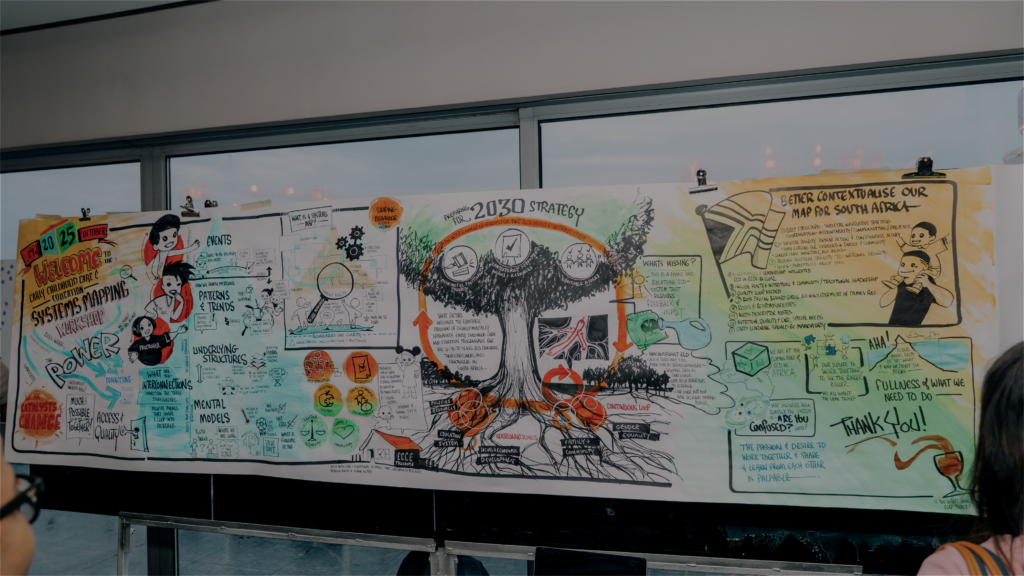
What the room surfaced was more layered than a simple diagnosis of what is broken. The systems mapping process revealed a sector with genuine momentum alongside deep structural friction — and being honest about both matters.
The bright spots are real. ECCE is rising as a political priority, reflected in recent policy shifts. Public awareness is growing. Strengthened data systems are improving planning. Active advocacy coalitions are beginning to align around shared priorities. And informal home and community-based programmes, operating in the most marginalised and hard-to-reach areas, continue to reach children who would otherwise have no access to early learning at all.
But the frozen points are equally real, and they are stubborn. Inequality continues to drive uneven access. Compliance barriers stall the expansion of affordable quality programmes. Children with disabilities are still excluded. And system fragmentation creates silos that dissipate effort rather than allowing it to add up to something greater.
The women who deliver early learning — as practitioners and as the parent figures making daily decisions about their children’s care — carry a weight that the system rarely acknowledges. For practitioners, this invisibility shows up in low wages, weak support and high attrition. For caregivers, it shows up in the absence of information, services and genuine support that would free them to make real choices about their own lives.
What the workshop also surfaced is where the catalytic leverage lies. We identified a set of shifts that, if unlocked, could move multiple parts of the system simultaneously — sustainable public financing; regulatory reform that supports diverse delivery modalities; stronger investment in practitioner development and remuneration so that ECCE practice becomes a viable, recognised profession; and more deliberate partnerships between the state and those who support delivery — because while government is the duty bearer, universal access cannot be achieved without partners, and those relationships need to be better structured and more intentionally supported.
The systems mapping process offers a shared picture of how the system actually works — who connects to whom, where effort is being absorbed without impact, and where a shift in one place could unlock movement in others.
The full report is available on our website and can be accessed using the button below. We share it as a tool for ongoing learning and alignment — and as an invitation to keep having this conversation, collectively.
With an innovative social franchise model, SmartStart is providing early childhood education for South Africa’s children—and economic opportunity for communities
Washington, DC, April 7, 2026—Today, the Skoll Foundation announced SmartStart as one of the three organisations that will receive the 2026 Skoll Award for Social Innovation. The award provides unrestricted support to nonprofit organisations with a proven track record of advancing transformational social change on intractable global issues.
Through innovative public-private partnerships, thoughtful community integration, and systems-level thinking, the 2026 award winners are driving measurable progress on child health in Pakistan, early learning and development in South Africa, and civic technology and public benefits access in India. Together, these remarkable organizations are advancing a sustainable world of peace and prosperity for all.
The Foundation will present the awards and celebrate the leaders of each recipient organization during the 23rd annual Skoll World Forum, held April 21–24 in Oxford, U.K. and online. The Awards Ceremony will take place Thursday, April 23, from 5:00–6:30 p.m. BST at the New Theatre in Oxford and via livestream. Click here to register to attend the Forum online, or email press@skoll.org to request a press pass to attend the Forum in person.
“This recognition strengthens our resolve to tackle poverty at its roots, because there is no way we can put up a fight against poverty without working on the system as a whole,” said CEO Grace Matlhape. “Early childhood development is one of the most powerful levers we have to break the cycle of intergenerational poverty, and this award helps us deepen and scale that work. The recognition truly belongs to the thousands of women in the SmartStart network and to our implementation partners, whose hard work and commitment are changing children’s lives every day.”
“This year’s winners of the Skoll Award for Social Innovation prove that when bold, creative leaders set their sights on a problem, their resolve and commitment lead to global systems change. Through innovative partnerships with affected communities and cross-sector collaboration, they are driving impact and lasting change in the fields of health, education, and public benefits,” said Marla Blow, CEO & President of the Skoll Foundation. “Even in the face of profound shocks to the social impact space, these organizations are not simply maintaining their impact; they are increasing it exponentially. We hope their stories will inspire other social entrepreneurs to continue their pursuit of transformational change.”
More details about SmartStart:
High-quality early childhood care and education boosts child outcomes, creates new jobs and enables parents to work. Yet in South Africa, over one million 3- to 5-year-olds don’t have access, perpetuating the economic exclusion of poor communities. SmartStart’s model enables underemployed community members to convert their homes and community spaces into licensed early learning enterprises for excluded children. By combining training, materials, coaching, compliance support and peer networks, SmartStart’s social franchise model makes quality early learning affordable, accessible and community-owned. At the same time, the model unlocks stable, dignified livelihood opportunities for thousands of microentrepreneurs. Through deep collaboration with government and other partners, SmartStart has grown into South Africa’s leading early learning network, with 15,000 programs currently reaching 160,000 children per week. The organization is now building the systems, capabilities and partnership to grow its impact beyond its direct delivery footprint and reach 1 million children by 2030.
About the Skoll Foundation:
The Skoll Foundation catalyzes transformational social change by investing in, connecting and championing social entrepreneurs and other innovators who support them who are advancing bold, systemic solutions to the world’s most pressing problems. In 2025, the Skoll Foundation directed nearly 80 percent of its funding in support of global social entrepreneurship, with 55 percent directly reaching its community of Skoll Awardees and other social entrepreneurs.